
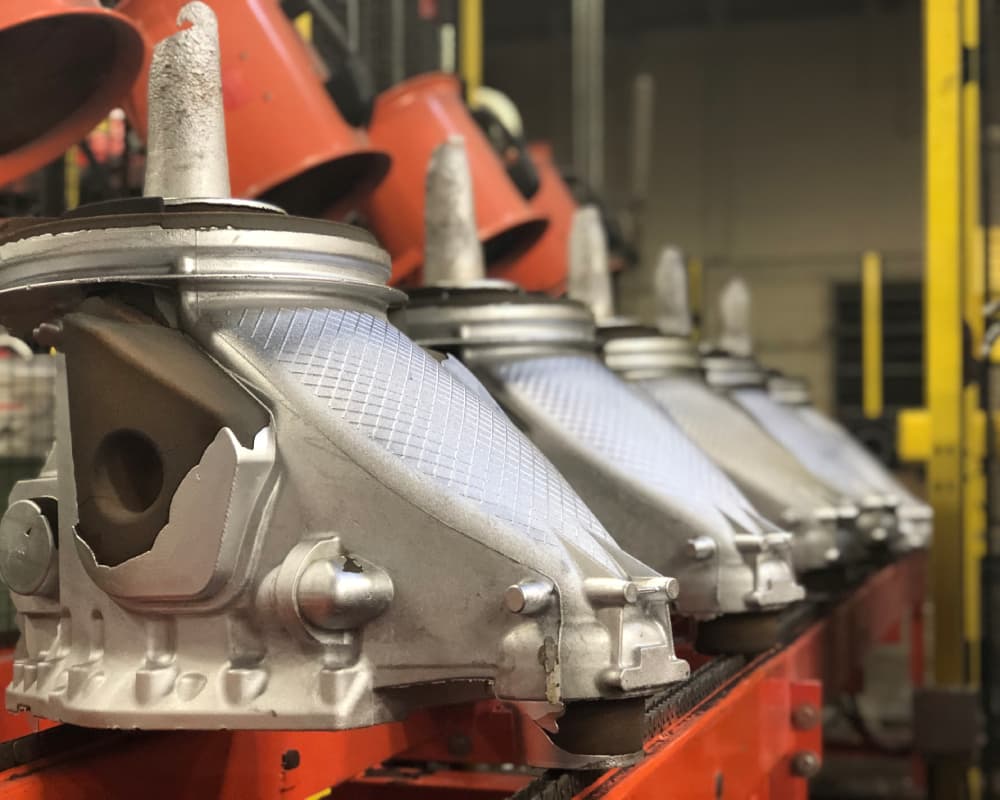
Aluminum casting production is a highly engineered manufacturing process that transforms raw aluminum alloy into precision components used across industries such as hydraulics, automotive, heavy equipment, robotics, and power generation.
While the final product may appear simple, each casting goes through multiple tightly controlled stages to ensure dimensional accuracy, structural integrity, and long-term performance. Understanding these stages is essential for OEMs and engineers selecting the right aluminum casting partner.
Below is a comprehensive breakdown of the key stages of aluminum casting production.
1. Engineering, Design & DFM Analysis
Every successful casting begins long before molten metal is poured.
At this stage, engineers collaborate with customers to review:
- Part geometry
- Wall thickness consistency
- Structural load requirements
- Internal passage design
- Machining allowances
- Alloy selection
Design for Manufacturability (DFM) is critical. Proper gating, riser placement, and draft angles are engineered to ensure smooth metal flow, minimize porosity, and optimize yield. Early engineering involvement reduces tooling revisions and shortens time to production.
2. Tooling & Mold Development
Once the design is finalized, tooling is manufactured.
Depending on the casting method, molds may include:
- Permanent steel molds
- Semi-permanent molds with sand cores
- Sand molds for larger components
Permanent mold tooling is precision-machined to tight tolerances to ensure repeatable production. Cooling channels and mold coatings are applied to control solidification rates and improve surface finish.
Tooling quality directly impacts:
- Dimensional repeatability
- Surface finish
- Casting integrity
- Long-term production efficiency
3. Core Making as Required
For parts requiring internal cavities, passages, or complex geometries, sand cores are produced separately and inserted into the mold before pouring.
Cores must be:
- Dimensionally accurate
- Structurally stable under molten metal pressure
- Properly vented to prevent gas defects
Core design plays a significant role in hydraulic housings, pump bodies, and structural castings with internal fluid channels.
4. Melting & Alloy Preparation
Aluminum alloy preparation is one of the most critical stages in casting production.
Raw aluminum ingots and recycled material are melted in controlled furnaces. During melting:
- Alloy chemistry is verified using spectrometer analysis
- Degassing removes hydrogen and dissolved gases
- Dross is removed
- Temperature is tightly monitored
Precise alloy control ensures the casting meets required mechanical properties such as tensile strength, yield strength, and elongation.
5. Pouring the Molten Aluminum
Once the alloy is ready, molten aluminum is transferred to the mold.
Modern foundries often use automated tilt-pour systems to ensure:
- Controlled metal flow
- Reduced turbulence
- Minimized air entrapment
- Lower porosity risk
- Consistent fill rates
Proper pouring technique is essential for maintaining metallurgical integrity and avoiding casting defects.
6. Solidification & Cooling
After pouring, the aluminum begins to solidify inside the mold.
Controlled cooling rates influence:
- Grain structure
- Mechanical strength
- Internal stress levels
- Surface quality
Permanent mold casting typically produces faster cooling rates than sand casting, resulting in improved mechanical properties and finer grain structure.
Proper solidification management prevents shrinkage defects and internal voids.
7. Shakeout & Casting Removal
Once fully solidified, the casting is removed from the mold.
At this stage:
- Gates and runners are trimmed
- Excess flash is removed
- Surface cleaning begins
The casting now takes its recognizable near-net shape.
8. Heat Treatment as Required
Many aluminum castings undergo heat treatment to enhance mechanical properties.
Common heat treatment processes include:
- Solution heat treatment
- Quenching
- Artificial aging
Heat treatment improves:
- Strength
- Hardness
- Fatigue resistance
- Dimensional stability
This step is particularly important for structural and high-performance applications.
9. Cleaning, Finishing & Surface Preparation
Castings are cleaned to remove any remaining sand, scale, or surface contaminants.
Processes may include:
- Shot blasting
- Grinding
- Robotic trimming
- Surface smoothing
Automated finishing improves repeatability and reduces variation in part appearance and surface condition.
10. In-Process Quality Inspection
Quality control is integrated throughout production—not just at the end.
Modern aluminum foundries utilize:
- Real-time X-ray inspection
- Dimensional verification using CMM
- Visual inspection protocols
- Spectrometer alloy verification
- Statistical process control
Early defect detection prevents downstream machining waste and ensures process stability.
11. CNC Machining & Secondary Operations
Most aluminum castings require precision machining before shipment.
In-house CNC machining allows:
- Milling
- Turning
- Drilling
- Tapping & threading
- Precision boring & reaming
- Flatness control of sealing surfaces
Machining ensures tight tolerances, accurate hole positioning, and functional surfaces required for assembly.
Integrating machining within the foundry improves quality control and reduces overall lead time.
12. Leak Testing & Final Validation
For hydraulic, pressure, or fluid-handling components, leak testing is essential.
Testing methods may include:
- Helium pressure decay testing
- Air-under-water testing
- Pressure verification systems
Final mechanical testing may also confirm tensile strength, yield strength, and elongation.
Only after passing these validation steps is the casting approved for shipment.
13. Packaging & Delivery
Proper packaging protects castings during transport and storage.
Depending on customer requirements, castings may be:
- Individually protected
- Custom palletized
- Barcoded for traceability
- Shipped as raw castings or fully machined components
Traceability documentation often accompanies each production batch.
Why Every Stage Matters
Each stage in aluminum casting production impacts:
- Structural integrity
- Dimensional accuracy
- Surface quality
- Performance reliability
- Total production cost
A breakdown in any step—tooling design, alloy chemistry, pouring control, or inspection—can compromise final part quality.
That’s why partnering with an experienced, automation-driven aluminum foundry ensures that every stage is optimized for consistency, safety, and repeatability.
Partner With a Foundry That Controls Every Stage
From DFM engineering and precision tooling to automated pouring, real-time X-ray inspection, and in-house CNC machining, advanced aluminum casting facilities maintain strict control over every production stage.
If your application requires high-performance aluminum castings backed by rigorous process control and quality validation, working with a fully integrated foundry partner is essential.
Contact our team today to discuss your next aluminum casting project.