
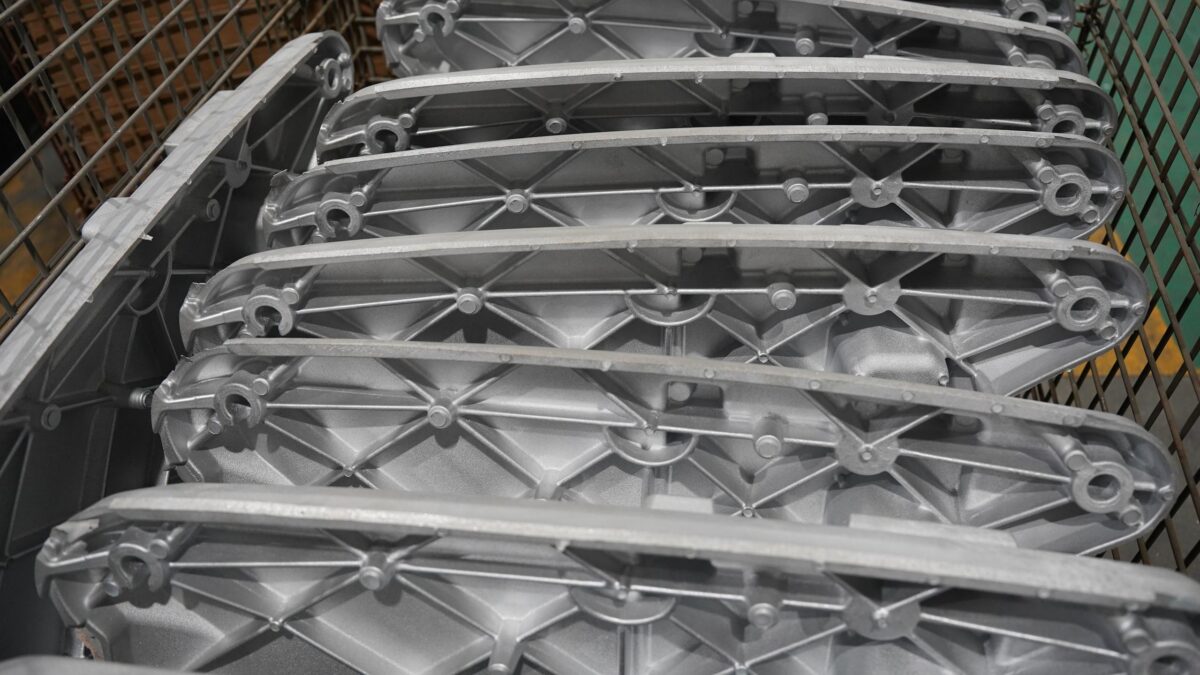
OEMs can reduce total cost of ownership by choosing aluminum casting solutions that improve manufacturability, reduce component weight, consolidate production steps, support repeatable quality, and simplify the supply chain.
The lowest part price does not always create the lowest long-term manufacturing cost. Tooling, machining, inspection, finishing, logistics, assembly, production variability, and supplier coordination can all affect the true cost of a component over the life of an OEM program.
Watry Industries approaches permanent mold aluminum casting as part of a complete manufacturing system. By integrating automated casting, engineering, CNC machining, finishing, and value-added services within one U.S.-based operation, Watry helps OEM teams evaluate cost across the full production process.
What Does Total Cost of Ownership Mean for an Aluminum Casting?
Total cost of ownership looks beyond the initial quoted price of a casting.
For an OEM, the true cost of a component may include:
- Casting production
- Tooling and fixtures
- CNC machining
- Heat treating
- Coating and finishing
- Inspection
- Assembly
- Packaging and transportation
- Supplier management
- Production delays
- Quality-related rework
- Long-term production efficiency
A component with a lower unit price may create more cost elsewhere if it requires additional suppliers, more machining, extra handling, or greater process variability.
Evaluating the entire manufacturing sequence gives engineering and procurement teams a clearer view of long-term value.
How Can Aluminum Reduce Costs Through Component Weight?
Aluminum offers a favorable strength-to-weight ratio, which can make it useful for OEM components where weight affects equipment design or performance.
Reducing component weight may allow engineers to simplify surrounding structures, reduce moving mass, or improve handling during manufacturing and assembly.
Aluminum also provides corrosion resistance and dimensional stability, which can support applications where long-term material performance is important.
The financial benefit depends on the application, but material selection should be evaluated as part of the overall equipment design rather than only as a raw material cost.
For some OEM programs, a well-designed aluminum casting can provide a more efficient balance between weight, performance, manufacturing requirements, and long-term production cost.
How Can Part Consolidation Lower Manufacturing Costs?
Casting gives engineers the ability to integrate multiple features into a single component.
Ribs, bosses, mounting points, housings, and other structural features may be incorporated directly into the casting geometry instead of being produced as separate parts.
When appropriate for the design, this can reduce:
- Individual part count
- Fasteners
- Welding or joining operations
- Separate fabrication steps
- Assembly labor
- Inventory requirements
- Supplier coordination
Semi-permanent mold casting and sand core integration can also support more complex geometries when internal features are required.
Part consolidation must still be evaluated carefully. Tooling, casting geometry, machining access, wall thickness, and production volume all influence whether consolidation creates a practical manufacturing advantage.
Watry provides engineering support, simulation, CAD design, and tooling capabilities to help OEM teams evaluate these factors before production.
How Does Design for Manufacturability Affect Total Cost?
Manufacturing cost is often determined early in the design process.
A component that is difficult to cast or machine may require additional production steps, complex tooling, or unnecessary material removal. These costs can continue throughout the life of the program.
Watry supports OEM engineers with:
- Casting design consultation
- Simulation-driven mold and casting design
- CAD design for molds and fixtures
- Mold and fixture design and build
- Engineering support
- Machining considerations
Reviewing manufacturability early can help identify opportunities to simplify the production process before tooling and full-scale manufacturing begin.
This is especially important for castings that require thin walls, internal geometries, CNC machining, coatings, or downstream assembly.
The objective is not simply to make a design castable. It is to create a component that can be produced repeatedly and efficiently at the required volume.
How Can Permanent Mold Casting Improve Long-Term Production Efficiency?
Permanent mold casting uses reusable molds rather than creating a new mold for each production cycle.
For suitable OEM applications, this supports repeatable production and consistent component geometry across ongoing manufacturing programs.
Watry provides several aluminum permanent mold casting methods, including:
- Gravity permanent mold casting
- Traditional tilt pour casting
- Reverse tilt pour casting
- Semi-permanent mold casting
- Sand core integration for complex geometries
The permanent mold process also supports the dimensional consistency and surface quality required for many OEM components.
For programs with recurring production demand, repeatable tooling and controlled casting processes can help create a more predictable manufacturing environment over time.
How Do Automation and Robotics Reduce Production Variability?
Variation creates cost.
When production results change from one cycle to another, manufacturers may experience additional inspection, rework, scheduling disruptions, or downstream manufacturing problems.
Watry uses robotic pouring and extraction systems along with automated machining and finishing cells. These systems support repeatable production sequences while reducing labor variability.
Automation can contribute to:
- More consistent production cycles
- Reduced manual handling
- Greater throughput
- Improved equipment utilization
- Repeatable component processing
- More scalable manufacturing
These advantages become particularly important when an OEM program moves into higher production volumes.
Watry supports annual production ranging from approximately 300 pieces to more than 600,000 parts, making repeatable production systems important across different manufacturing scales.
How Does Quality Control Affect Total Cost of Ownership?
Quality issues can create costs far beyond the casting itself.
Dimensional variation or production inconsistency can affect machining, assembly, scheduling, and the performance of surrounding components.
Watry maintains an ISO 9001:2015 quality management system and uses dimensional inspection, process controls, continuous improvement systems, and vision inspection for assembly validation.
The goal is to control quality throughout manufacturing rather than relying only on final inspection.
This approach helps support predictable production across repeated manufacturing cycles.
For OEM procurement and engineering teams, consistent quality can reduce the uncertainty associated with rework, process corrections, and downstream disruptions.
How Can Integrated CNC Machining Reduce Manufacturing Costs?
Many aluminum castings require machined surfaces, holes, bores, or other precision features before they can be installed into an OEM assembly.
When casting and machining are handled by separate suppliers, the OEM may need to manage additional transportation, scheduling, inspection, and communication.
Watry provides precision CNC machining using horizontal and vertical machining centers as part of the same manufacturing operation as its casting processes.
Integrating these operations can reduce supplier handoffs and allow casting and machining requirements to be considered together.
Engineering teams can evaluate:
- Machining stock
- Datum locations
- Fixture design
- Tool access
- Dimensional relationships
- Casting geometry
before the component moves into full production.
This integrated approach can create a more direct manufacturing path from cast component to finished machined part.
How Can Finishing and Assembly Services Reduce Supplier Complexity?
A casting may require several additional processes after machining.
Watry’s value-added manufacturing capabilities include:
- Heat treating
- Powder coating
- Specialty finishing
- Sub-assembly
- Pad printing
Heat treating options include T4, T5, T6, T7, and variations. Watry also provides in-house powder coating with a multi-stage wash system.
When these processes are coordinated through a single manufacturing partner, OEMs may be able to reduce the number of separate suppliers involved in completing a component.
Fewer suppliers can mean fewer purchase orders, fewer shipments, fewer production handoffs, and fewer points where communication can break down.
This can simplify procurement while creating greater continuity across the manufacturing process.
How Does a Single-Source Supplier Affect Total Cost?
Supplier management has its own cost.
Every additional manufacturer involved in a component program requires communication, scheduling, transportation, quality coordination, and administrative oversight.
Watry combines permanent mold casting, CNC machining, engineering, tooling, heat treating, powder coating, finishing, and assembly capabilities within its Sheboygan, Wisconsin operation.
This allows OEMs to source anything from raw castings to more fully finished components through one manufacturing partner.
A more integrated supplier relationship can help reduce:
- Transportation between manufacturing stages
- Production scheduling complexity
- Multiple quality handoffs
- Separate supplier communications
- Administrative workload
- Supply chain coordination
For long-term OEM programs, these operational efficiencies can contribute meaningfully to total cost of ownership.
How Can Production Scalability Protect Long-Term Costs?
An OEM program may not stay at the same production volume throughout its life.
Demand can increase, decrease, or shift as equipment programs mature.
Watry supports production volumes ranging from approximately 300 pieces annually to more than 600,000 parts per year. This broad production range allows the same manufacturing operation to support different program scales.
Automation, robotic systems, universal mold mounting, and integrated machining help create a production environment designed for scalability.
For OEMs, working with a supplier capable of supporting changing demand can reduce the need to transition a successful component to a different manufacturing source as volumes increase.
Supplier transitions can introduce new tooling, qualification, scheduling, and quality risks. Scalable production capability can help avoid some of that disruption.
What Should OEMs Evaluate Beyond the Initial Casting Price?
When comparing aluminum casting suppliers, OEM procurement teams should consider the complete manufacturing program.
Important questions include:
- Can the supplier support the required production volume?
- Is engineering support available before tooling begins?
- Can the casting design reduce unnecessary secondary operations?
- Is machining available within the same manufacturing operation?
- How is dimensional consistency controlled?
- Can finishing and assembly be integrated?
- Does the supplier have a documented quality management system?
- How much transportation is required between production stages?
- Can the supplier support the program as production demand changes?
A lower quoted casting price may not provide the best overall value if the component requires additional manufacturing complexity elsewhere.
Total cost of ownership provides a broader framework for comparing suppliers and production strategies.
How Does Watry Help OEMs Control Long-Term Manufacturing Costs?
Watry Industries combines automated permanent mold aluminum casting with engineering, CNC machining, quality systems, and value-added manufacturing.
Its manufacturing capabilities include robotic pouring and extraction, a universal mold mounting system, integrated machining, heat treating, powder coating, finishing, and sub-assembly.
This allows Watry to approach each component as part of a complete production process rather than as an isolated casting operation.
For OEM engineers and procurement teams, the result is a manufacturing strategy focused on repeatability, production efficiency, scalability, and reduced supplier complexity.
Watry manufactures aluminum castings from approximately 1 pound to more than 150 pounds and serves manufacturers nationwide and globally from its Sheboygan, Wisconsin operation.
Speak with the Watry team to discuss your component design, production requirements, machining needs, and opportunities to improve total manufacturing cost.
Frequently Asked Questions About Aluminum Casting Total Cost of Ownership
Is the lowest-priced aluminum casting always the lowest-cost option?
No. OEMs should also consider machining, finishing, assembly, transportation, quality control, supplier management, and long-term production efficiency when evaluating total cost.
Can aluminum castings reduce the number of parts in an assembly?
In some applications, yes. Casting can allow multiple features to be incorporated into a single component, potentially reducing separate parts and assembly operations.
Can Watry provide finished components instead of only raw castings?
Yes. Watry can provide raw castings, machined components, and more fully finished parts using integrated CNC machining, heat treating, powder coating, finishing, and sub-assembly capabilities.
How does automation affect manufacturing cost?
Automation can reduce labor variability, support repeatable production, increase throughput, and improve manufacturing efficiency across recurring production cycles.
Can Watry support both lower-volume and high-volume OEM programs?
Yes. Watry supports production volumes from approximately 300 pieces annually to more than 600,000 parts per year.