
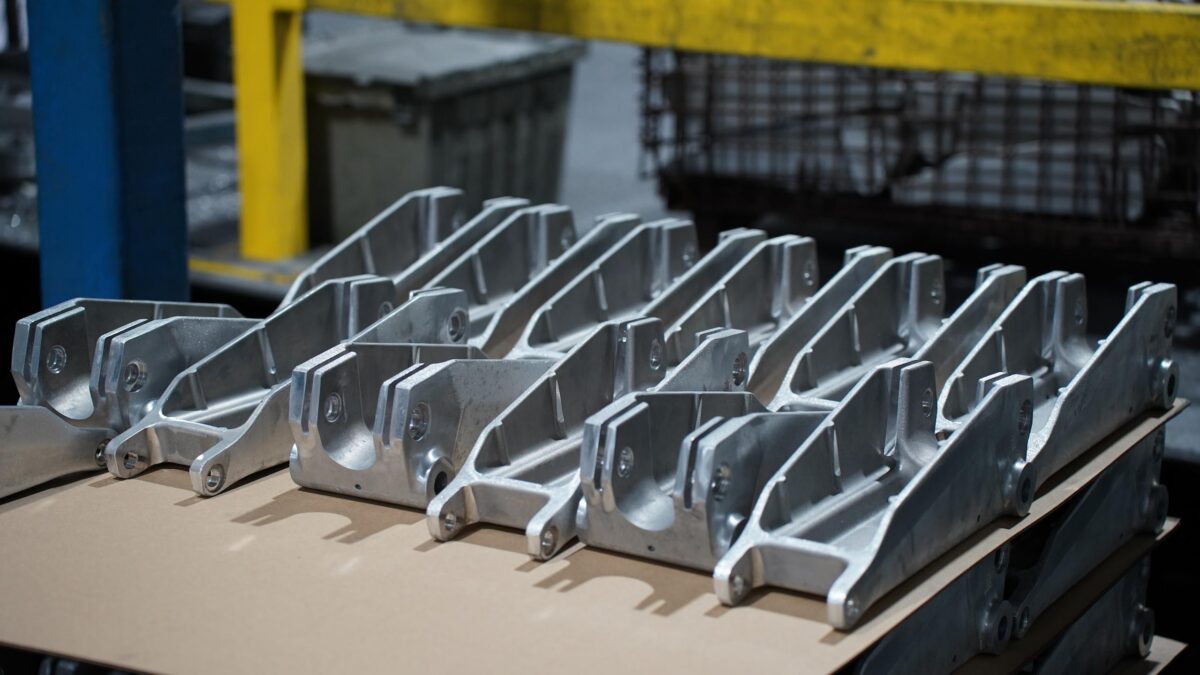
An aluminum foundry produces metal components by melting aluminum, pouring it into molds, and finishing the parts to meet specific engineering requirements. While the basic concept is straightforward, modern foundries operate as highly controlled manufacturing environments that integrate casting, machining, and finishing into a single production system.
For OEMs and engineers, an aluminum foundry is not just a supplier of raw castings. It is a manufacturing partner responsible for delivering consistent, high-quality components ready for assembly or further processing.
How Does the Aluminum Casting Process Work?
The casting process begins with melting aluminum alloys and preparing molds designed to shape the final component.
The core steps include:
- Melting aluminum to a controlled temperature
- Pouring molten metal into a mold cavity
- Allowing the metal to solidify under controlled conditions
- Removing the casting from the mold
- Cleaning and preparing the part for further processing
Each step must be carefully controlled to ensure the final part meets dimensional and structural requirements.
What Types of Casting Methods Are Used?
Aluminum foundries use different casting methods depending on part complexity, volume, and performance requirements.
Common methods include:
- Permanent mold casting for repeatable, high-quality parts
- Semi-permanent mold casting for more complex geometries
- Gravity casting for controlled solidification
- Sand core integration for internal features
The chosen method affects everything from surface finish to mechanical properties and production efficiency.
What Happens After the Casting Is Made?
After casting, parts typically require additional processing to meet final specifications.
These secondary operations may include:
- Removing excess material or flash
- Heat treating to achieve desired material properties
- Surface finishing or coating
- Inspection and quality verification
These steps ensure that the casting is ready for its intended application.
How Does CNC Machining Fit Into the Process?
CNC machining is often used to refine castings and achieve precise tolerances.
Machining operations are used to:
- Create critical features such as holes and threads
- Ensure flatness and alignment of surfaces
- Meet tight dimensional tolerances
- Prepare parts for assembly
By combining casting and machining, foundries can deliver components that meet both structural and precision requirements.
What Role Does Engineering Play in a Foundry?
Engineering is a central part of modern aluminum foundry operations.
Engineering teams are responsible for:
- Designing molds and tooling systems
- Optimizing part geometry for manufacturability
- Running simulations to predict casting performance
- Improving process efficiency and quality
This ensures that parts are not only produced but produced in the most efficient and reliable way possible.
How Do Foundries Ensure Quality?
Quality control is integrated into every stage of production.
Foundries maintain quality through:
- Controlled process parameters during casting
- Dimensional inspection and verification
- Testing for defects and structural integrity
- Continuous monitoring and improvement systems
These practices ensure that each part meets required specifications and performance standards.
What Does “Single-Source Manufacturing” Mean?
Many modern foundries operate as single-source manufacturing partners, meaning they handle multiple stages of production in-house.
This includes:
- Casting
- Machining
- Finishing and coating
- Assembly support
Single-source manufacturing reduces reliance on external vendors and improves coordination across production stages.
What Industries Rely on Aluminum Foundries?
Aluminum foundries support a wide range of industries that require durable, lightweight, and corrosion-resistant components.
Common industries include:
- Automotive
- Marine
- Agricultural equipment
- Power generation
- Electrical and data infrastructure
- Industrial machinery
These industries rely on foundries for components that must perform reliably under demanding conditions.
How Do Modern Foundries Use Automation?
Automation plays a significant role in improving efficiency and consistency.
Modern foundries use automation to:
- Control pouring and handling processes
- Maintain consistent cycle times
- Reduce variability in production
- Increase throughput without sacrificing quality
Automated systems allow foundries to scale production while maintaining repeatable results.
Why Is Process Control Important in Foundry Operations?
Process control ensures that every step of production is consistent and predictable.
Key benefits include:
- Reduced defects and rework
- Improved dimensional accuracy
- Stable production performance
- Reliable delivery timelines
Without strong process control, variability can impact both quality and efficiency.
Conclusion: Foundries Deliver More Than Raw Castings
An aluminum foundry does far more than pour metal into molds. It operates as a controlled manufacturing system that combines engineering, casting, machining, and finishing to produce complete components.
For OEMs, working with a capable foundry means gaining a partner that can support design, production, and long-term performance requirements.
Ready to Work With a Full-Service Aluminum Foundry?
If you are sourcing aluminum components, partnering with a foundry that offers integrated capabilities and controlled production processes can improve both quality and reliability.
At Watry Industries, casting, machining, and finishing are integrated within a highly automated environment designed to deliver consistent, high-quality components at scale.
Speak with our team to discuss your application and production requirements.